
AP WORKFLOW SOLUTIONS
AP WORKFLOW SOLUTIONS

With so much content competing for attention across so many platforms, digital storytelling has never been more complex — or more consequential.
News and media organizations are no longer just competing with each other. They’re competing with algorithms, AI-generated content, independent creators, and an audience whose expectations are constantly being reset.
The organizations that will win are the ones building workflows and strategies around where content is going — not where it’s been.
Here are six trends shaping the future of digital content creation.
Pioneering Trends in Content Creation6 influencing factors on the future of digital content |
|
| Artificial Intelligence & Machine Learning | AI has moved from novelty to infrastructure. The real question now is how to deploy it responsibly — accelerating production without eroding editorial standards or audience trust. |
| Liquid Content | One story, every format. Content that flows automatically across platforms — adapting shape without losing substance — is becoming a competitive necessity. |
| Short-form Video | Already dominant, short-form video is now a primary storytelling format — not a repurposing exercise. Newsrooms need workflows built to produce it natively. |
| Authenticity & Human-Led Storytelling | Audiences are pushing back against AI-generated content. Editorial judgment, reporter identity, and genuine voice are now differentiators, not baseline expectations. |
| Podcasting & Direct Publishing | On-demand audio and direct-to-reader publishing have redrawn the relationship between journalists and their audiences. The organizations that retain both will be the ones giving journalists the tools to do their best institutional work. |
| AI Powered Curation & Personalization | Audiences trained by streaming and social algorithms now expect news that feels relevant to them. AI makes this possible at scale — with the right editorial guardrails. |
Below, we’ll inspect each of these trends in closer detail.
Artificial
Intelligence
& Machine
Learning
AI is no longer a trend to watch — it’s already embedded in the workflow. The question has shifted from “should we use it?” to “how do we use it well?”
For newsrooms, that means AI is quietly handling transcription, metadata tagging, content summarization, and audience analytics while journalists focus on the work that requires judgment, context, and trust. But the more significant shift is happening at a different level. Agentic AI — systems that don’t just respond to prompts but plan, execute, and complete multi-step tasks autonomously — is moving from research labs into real production environments. In a newsroom context, that means AI that can monitor a data source, identify a story, draft a first version, and route it for editorial review without a human initiating each step.
The tools have matured rapidly: where early conversation centred on novelty, the real discussion in 2026 is about responsible integration — how to deploy AI in ways that accelerate production without eroding editorial standards. Agentic workflows raise that question more sharply than anything before them, because the human is no longer in the loop at every stage by default. Getting the guardrails right matters more, not less.
The Associated Press has been at the forefront of this, developing AI applications that assist journalists rather than replace them. The lesson from organizations doing this well is consistent: AI works best as infrastructure, not authorship. It handles the repetitive and the routine; humans own the story.
Liquid content is the idea that a single story should flow seamlessly across every platform and format — adapting its shape without losing its substance. A breaking news story becomes a 60-second video, a push alert, a long-read, a social post, and a podcast clip, all from the same source material, without a journalist manually rebuilding each one from scratch.
This is becoming newly achievable. The convergence of AI-assisted production tools and story-centric workflows means that adaptation can happen at the point of publication rather than as a downstream task.
For broadcasters and digital newsrooms, liquid content isn’t just an efficiency gain — it’s a competitive necessity. Audiences don’t follow formats; they follow stories. Tools like AP Storytelling are built around exactly this principle: putting the story at the centre, and letting distribution flow from there.
Short-orm video has graduated from a trend to a primary content format. YouTube Shorts now registers over 70 billion daily views. TikTok is forecast to surpass 2.2 billion monthly active users by the end of 2026. Instagram Reels accounts for 40% of time spent on Meta’s platforms. These aren’t side channels anymore — they’re where audiences live.
For news organizations, the implication is structural. Short-form video can no longer be treated as a repurposing exercise, where a broadcast segment gets trimmed and reposted. The format requires its own editorial thinking: tighter framing, faster payoff, and a clear point of view that lands in the first three seconds.
The smartest organizations are using short-form as a discovery engine — bringing audiences in, then guiding them toward deeper coverage. That requires production workflows built to move fast without sacrificing accuracy.
This trend has been driven by changing consumer habits and preferences, as people increasingly turn to bite-sized content that is easy to digest and share.
Other reasons behind the popularity of short-form video content include:
TikTok has completely changed how users consume digital content. Its short-form format is incredibly popular with younger audiences: notably, over 70% of its global users are under the age of 34 (Statista).
The platform has been praised for its algorithm, which is seen by many as more democratic than other social media platforms. Many digital media organizations have had success with TikTok, and growth is expected to continue exponentially.
At least partly in response to the rise of TikTok, Facebook and Instagram have adapted their platforms to offer more short-form video through their Meta Stories feature.
This allows content creators to produce and share short videos with their followers, with a range of tools and features to enhance the content.
Digital creators can utilize video content with Meta Stories to reach a wider audience and engage with followers in a more interactive way.
YouTube creators are also coming around to the short-form video revolution. YouTube Shorts allows creators to make videos that are 60 seconds or less, with a focus on engaging, TikTok-style content. This presents a new way to engage with audiences on a platform that has traditionally been associated with longer-form video.
The flood of AI-generated content has produced a powerful counter-reaction: audiences are actively seeking out content that feels demonstrably human. Research consistently shows that human-produced content outperforms AI-generated equivalents on engagement, trust, and time-on-page — and audiences are getting better at telling the difference.
For news organizations, this is good news. Credibility, editorial judgment, and reporter identity are things no AI can replicate at scale. The risk is in treating AI as a cost-cutting shortcut rather than a production tool — generating content that is technically accurate but tonally hollow.
The human element isn’t a liability to be minimized. In 2026, it’s a differentiator.
Podcasts &
Direct
Publishing
Podcasting has consolidated its position as a primary format for in-depth journalism. It is no longer competing with radio — it has largely replaced it for on-demand audio consumption. Audiences tune in on their own schedule, with a loyalty to specific shows that rivals any other media relationship.
For news organizations, the podcast’s real value is depth. It creates space for reporting and analysis that short-form formats cannot accommodate — extended interviews, narrative investigations, long-running series that build audience over time. That depth translates into trust, and trust translates into subscription and retention.
The same dynamic is playing out in written publishing. Platforms like Substack have demonstrated that audiences will pay directly for journalism they trust, bypassing traditional distribution entirely. For established news organizations, this is both a warning and an opportunity. The warning: journalists with strong personal followings can now leave and take their audience with them. The opportunity: the appetite for credible, in-depth reporting delivered directly to an inbox or podcast feed has never been stronger.
The production barrier for both formats has also dropped significantly. AI tools now handle transcription, editing assistance, and show notes generation, making it realistic for leaner teams to produce consistent, high-quality audio and written content without heavy infrastructure investment.
The organizations that will win in this space are the ones that give journalists the tools to do their best work institutionally — so the relationship stays between the reader and the newsroom, not just between the reader and the byline.
Audiences have been trained by streaming platforms and social algorithms to expect content that feels relevant to them specifically. That expectation is now driving news consumption. Generic homepages and one-size-fits-all newsletters are losing ground to experiences that adapt based on what a reader has engaged with, what topics they follow, and how they prefer to consume information.
AI-powered curation and personalization makes this possible at scale — surfacing the right story to the right reader in the right format. Done well, it increases engagement, reduces churn, and gives journalists better signal on what their audiences actually care about.
The caveat is real: personalization can narrow rather than broaden perspective. The organizations getting this right are using it to improve access to a full range of coverage, not just to feed readers what they already believe. That requires editorial guardrails alongside the technology.
The
Stories of
Tomorrow
The six trends above pull in different directions — more automation, more humanity; more formats, more focus; more personalization, more authenticity. That tension is the defining challenge for news organizations right now.
What resolves it isn’t any single tool or platform. It’s having a workflow that keeps the story at the centre and lets everything else — format, distribution, personalization — flow from there. Organizations that get that right will move faster and publish smarter, without trading away the editorial judgment that makes their journalism worth trusting in the first place.
Looking to modernize your newsroom workflow? Talk to us to learn how AP Workflow Solutions can help.
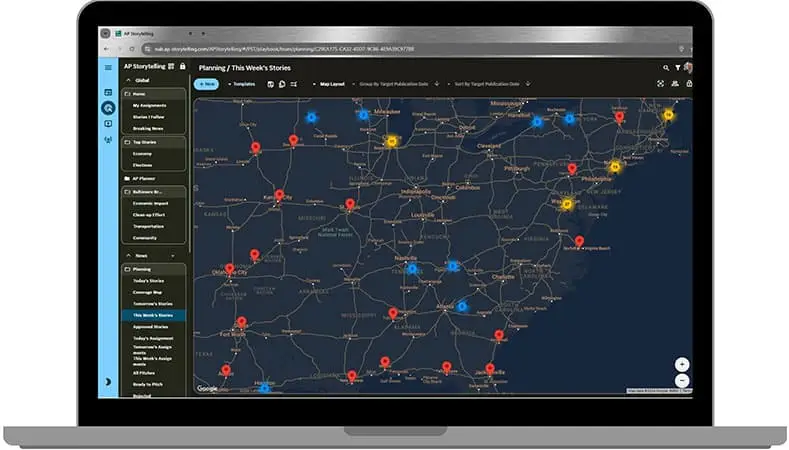
Your journalists are already telling the same story five different ways. AP Storytelling stops that. One place to plan, write and coordinate — every output, every platform, every team.
Browser-based, built for how newsrooms actually work, and already running in newsrooms from broadcast to digital.
Winner of TVB Europe, IBC Best of Show, 2024.
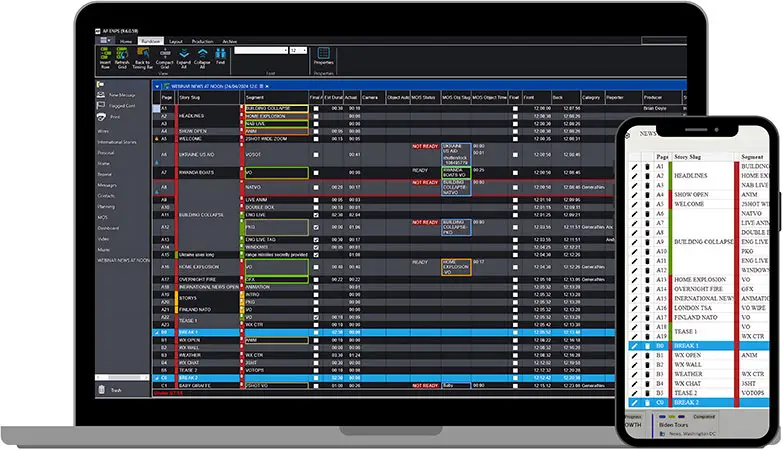
When the show goes live, there’s no room for surprises. AP ENPS has been the system broadcast newsrooms trust for live production for over 25 years — reliable, fast, and predictable under pressure.
650+ newsrooms worldwide run on it because it does exactly what it promises, every time.
Winner of 2 Emmy® Engineering Awards, 2016 and 2021.
Get in touch if you’d like to learn more about AI, content creation and story-centric workflows.
"*" indicates required fields