Now we’re building the next standard — with BBC, ITN, NBCUniversal, Channel 4, Al Jazeera, and the Washington Post.
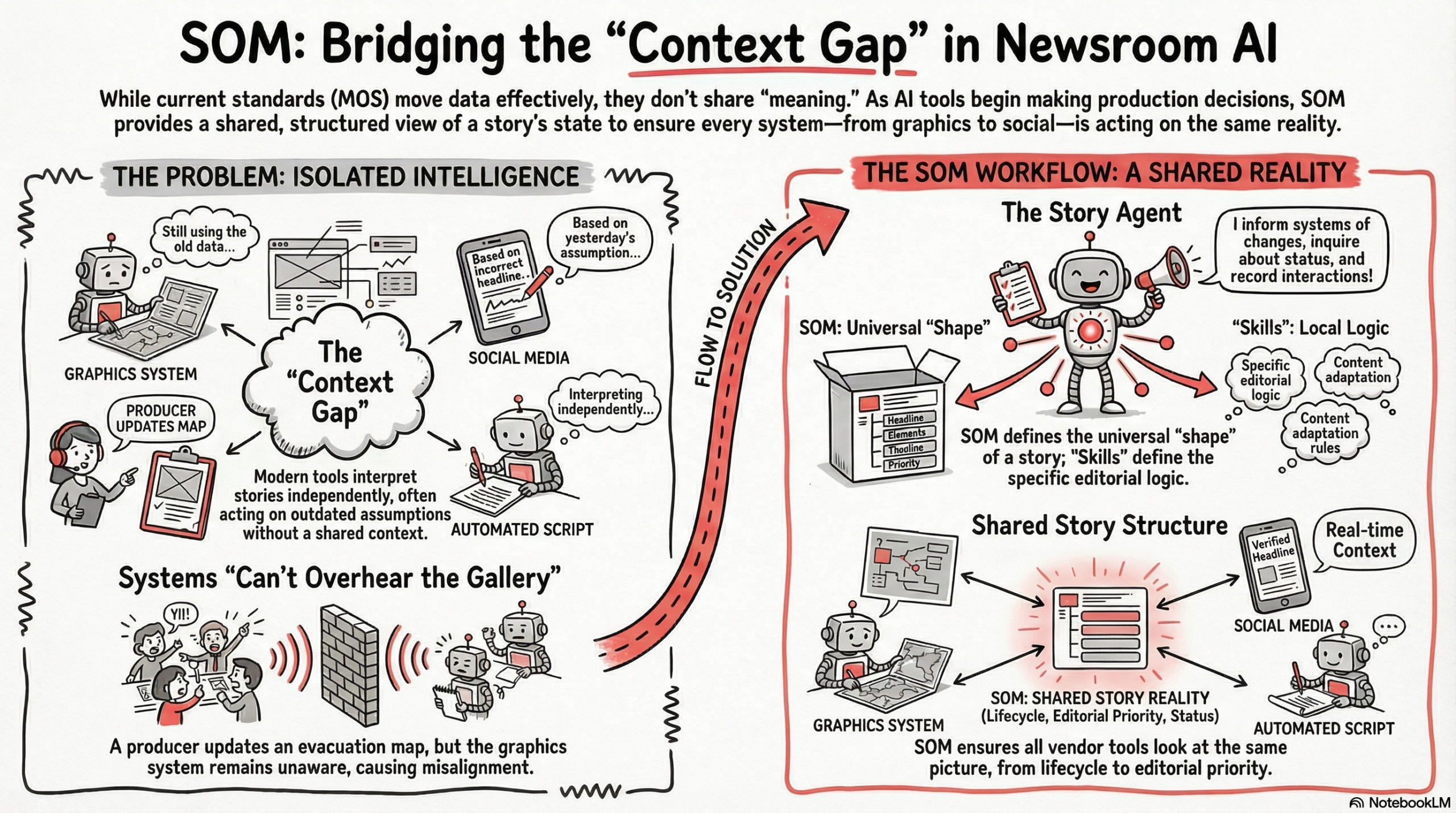
A fast-moving wildfire is spreading toward a residential area. Your graphics system is building a map based on the latest evacuation zone. Then emergency officials expand the boundary and the producer updates the story.
One system has the new version. Another is still working from the old one. Nobody told it. There was no way to tell it.
That’s the kind of gap modern newsrooms keep running into — not because systems can’t exchange data, but because they still struggle to exchange current story context.
MOS and the meaning layer
For more than 20 years, MOS has been doing exactly what it was built to do: reliably moving data between systems, helping multi-vendor workflows hold together under pressure, and supporting live broadcast operations at scale. It remains an important part of many newsrooms for a reason.
MOS was designed to solve a specific interoperability problem. It gives systems a shared pipe for data. Humans provide the meaning layer on top. Producers and editorial teams hold the larger picture, make the calls, and coordinate the exceptions.
That model still works. What’s changing is the environment around it.
A growing number of newsroom products now ship with AI-assisted features — suggested visuals, conflict alerts, metadata enrichment, related-content prompts. The degree varies widely and many workflows are still only partly automated. But the direction is clear: more tools are starting to interpret what’s happening around a story, not just pass information along.
Which raises a question the industry hasn’t fully answered yet: how do those tools stay aligned when the story changes?
A graphics assistant may not know a producer just changed the story focus. A recommendation engine may not know editorial status has shifted. A downstream tool may still be acting on assumptions that were accurate twenty minutes ago and aren’t anymore. It can’t overhear the gallery.
Modern workflows increasingly need a complementary way to share story context, not just data.
That's where Smart Stories comes in
SOM itself contains no intelligence. It's the shared structure. The intelligence stays inside each vendor's tools.
Through the IBC Accelerator Media Innovation Programme, AP is working alongside BBC, ITN, NBCUniversal, Channel 4, Al Jazeera, and The Washington Post to explore the Story Object Model — SOM — a proposed open standard for representing and sharing story context across vendor systems.
The idea is straightforward, even if the implementation isn’t. If connected systems can share a structured view of story state, lifecycle, editorial flags, priority, relationships, status changes — then AI-enabled features have a better chance of responding to the same reality the newsroom sees, rather than each acting on their own partial picture.
The working concept includes a Story Agent: one per story, persistent from tip-off through distribution. It helps connected systems stay aligned as context changes, inquires across the stack about what’s happening, and records every interaction to an auditable trail. Not a replacement for existing systems or standards — a coordination layer that can sit across them, including in MOS-based environments.
SOM itself contains no intelligence. It’s the shared structure. The intelligence stays inside each vendor’s tools. SOM’s job is just to make sure those tools are looking at the same picture of the story.
In the wildfire scenario, that means the graphics system knows the evacuation boundary changed — not because someone manually chased every downstream tool, but because the story context updated once and every subscribed system got the change.
The hard part
That’s the promise. The hard part is deciding what belongs in the shared model and what doesn’t.
The architecture separates SOM from Skills. SOM defines the common shape — the structure that can travel across organisations, vendors, and story types. Skills define the logic — editorial standards, compliance rules, show formats, and institutional practices that differ by organisation. BBC election coverage and an NBCUniversal entertainment show may use the same model while applying it very differently.
That boundary matters. Draw it too broadly and the standard becomes rigid. Draw it too narrowly and it becomes too thin to help.
So right now the work is less about grand claims and more about disciplined discovery. We’ve been mapping real stories from BBC, ITN, NBCUniversal, and AP to identify where production experiences truly converge and where they don’t. Where they converge may belong in SOM. Where they diverge may belong in Skills.
Our current view is that the shared layer may be smaller than people expect — and that’s fine. A useful common model doesn’t have to capture everything. It just has to capture the right things.
We’re also realistic about what we don’t know yet. The line we draw today may shift once vendors start building against it.
That’s not a flaw in the process. That is the process.
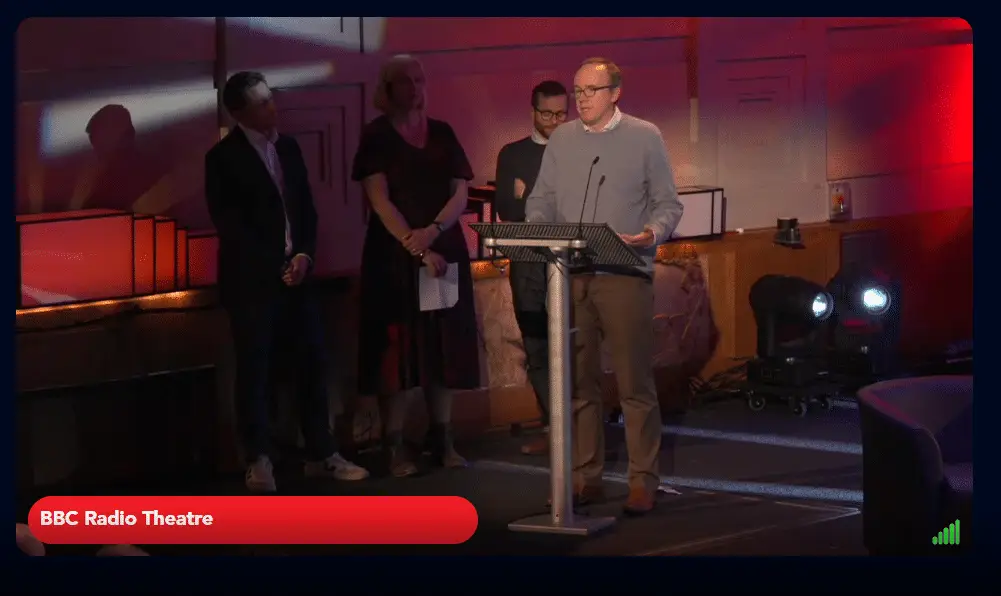
Brian Hopman, VP & General Manager – AP Workflow Solutions at the IBC Kickstart Day in February 2026.
Our current view is that the shared layer may be smaller than people expect — and that's fine. A useful common model doesn't have to capture everything. It just has to capture the right things.
Why we're sharing this now
The public draft SOM specification is due at IBC in September 2026. Between now and then we’ll share what we’re learning — what seems promising, what still feels unresolved, and where broader industry input can make the work stronger.
Because this only becomes useful if it belongs to more than one company.
If you’re building in this space — or trying to make increasingly automated systems in your stack coordinate more effectively — we’d like to hear what you’re seeing.
If you’re interested in joining the effort or would like to learn more about this industry initiative get in touch.
We’d be happy to set up a time to tell you more about the project and how you and your team can participate.